Showing posts with label reflection. Show all posts

Sunday, 6 April 2014

Documentation at Boldon.

http://www.boldonnurseryschool.co.uk

I decided last Thursday that I would spend the day with the children at Boldon Outdoor Nursery. I wanted to get an idea of the flow of the day, the way the routines worked and how children operated in this space. It wasn't an easy day for the staff, with a number of casuals replacing the regular educators who are presenting at a conference. Having me here has added to the mix and I sense that things are a little different for the children and therefor for everybody. It's ok though. A few mishaps are met with patience, kindness, ever present respect for children and each other. 

ROUTINE
The day begins with children in their family groups and they all get prepared to go outdoors. This is a busy time and the staff need their wits about them. Children remove shoes, put on waterproofs, wellies and jackets, then have play materials available on open shelves while they wait for their peers on mats. This process demands independence as well as dependence on adults to support them. Shoes have a home in boxes with photos of children on each box. The children's belongings are on hooks. They don't seem to have as many bags like we do as everything the children need are supplied by the centre. Soon everybody is ready and out they go. The space has a myriad of exciting open ended and exploratory play spaces and the children are highly engaged. There is also an indoor space, a workshop, that children can access. Some days in the week there is an artist educator working in this space with the children. 
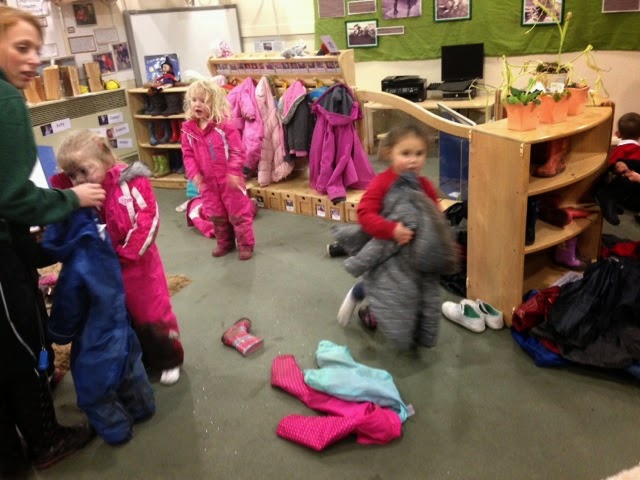


Hot chocolate and bottles of milk are available through the play time and children are free to get these themselves. At one point all the children are gathered around the fire for songs and a snack. Play then resumes until lunch time. All children come indoors and some are collected while others are given a hot lunch, as some stay all day. The water proofs, jackets and wellies are all taken off and shoes put on and the children again play with materials in their family groups until they are gathered for a group reflection, casual conversation or story as parents arrive to take the morning children home. The staff then manage a quick break before the afternoon children arrive and the routine begins again. 


DOCUMENTATION with Alison
As educators in early childhood this statement from Alison may resonate. "Documentation is something we are always grappling with. Although we've been working on it for years, we've never fully cracked it. There is so much we value, so many wonderful interactions, it's always hard to decide what will be documented and how." Sound familiar? 

Alison went on to share her expertise with me, and I must thank her here for her time and willingness to do so in her busy day. They work here from 8:30 to 4:30, but often stay much later and they only get a short break at lunch. 
So these are the things Alison shared with me. She began by pointing out:
*We need to consider the what, where and how, and this is dependent on the audience 
*We try to have a logic to how we go about it

I've noted here the various types of documentation that are developed and used at Boldon

Wall displays 

May be for parents, visiting professionals or the children
Based on big projects that have interested a lot of children
Involve children with a common interest or focus


Floor books 

Written with the children and document learning while it happens
Developed when children express an interest. 
Children and educators capture ideas through writing, drawing , mark making
Photos are taken and given to children to cut out and place on, usually by the next day and educators scribe the children's thinking
Possible Lines Of Direction (PLODS) are considered and developed by staff 
The projects go where the children lead
   Eg: an interest in sticks >> children attempting to join sticks >> introduce tools for joining wood >> a building project commences


Weekly journal

Each week a display is put up for parents in the form of a notice board with photos, quotes, items of interest or happenings during the week. The display includes a large book where a page is developed each week to inform parents of the children's learning, interests, focuses. 


Continuous provision

Provisions that occur on a daily basis are documented in a book available to parents and regulators. The environment is considered a third educator
Include the following titles: 
*learning opportunities, 
*role of the adult
*possibilities documented for each play area
These are the framework to the various provisions. Within this framework educators still consider:
*How it might be enhanced over time
*Plan for opportunities and possibilities. 
*How each learning area has the potential to hit all of the curriculum


Individual journals

Each child is provided with a learning journal. They include the following:
*Records of what happens for the whole centre
*About me page where parents contribute
*Key person profile that tells a little about the educator who is responsible for the child
*First days are documented
*Specific learning activities that the child has done and documented as annotated photographs
*Art work and educator reflection, often a photo
*Individual learning stories (parent and child friendly)
These are narratives written in first person 
*What I notice 
*Learning
*Possible next steps
Focus children. Each child gets a turn at being the focus child for the week and this involves parent input which is documented in the journal
*Send something home for parents
*Anything special, interests
*Notes from parent meeting and future directions for the child
*Key person comments and builds future directions for the child in response to the parent meeting. 


Assessment

Each educator needs to complete formal assessments on each child in their group, 26 per educator. These are required by Osted (our equivalent to ACECQA) and are based on their curriculum (similar to our EYLF)
Only one educator here is a teacher and there are 46 children attending daily. The legal ratio is 1:13 but Sue employs extra people to bring this down to about 1:8. The staff have varying levels of qualification that seem to be equivalent to our cert 111 and associate diploma
All educators have equal loads and responsibility in terms of documentation despite their level of qualification. 

Other forms of documentation   

The staff also document some of the key learning that they see taking place, using a journal, reflection style. Children may contribute also, but it's mostly the educators' ideas or thoughts. These are considered living, breathing documents that develop over time
For example
*A counting/numeracy book 
*Allotment book, what children are experiencing and learning from growing vegetables and keeping chickens
*Another example might be literacy and how children are responding to various forms

But wait, there's more

A parent book documents the learning and engagement of parents. 
A visitors book documents the responses, letters, thank you's from visitors

I asked Alison about the professional learning that was provided to support them in documentation. They have Professional Learning days, three a year, and all of the staff attended training for a day at Mindstretchers, with Kate and Claire Warden. This involved theory and presentations but also lots of practical hands on examples of how to use floor books, mind maps and journals. This helped them to come up with ways forward and they've been tweaking it ever since. 


All I can say is WOW! The work that is done is comprehensive, authentic and contextual to each child. I could see children's development throughout.

So that's basically what I wanted to share from my last few days at Boldon. I'll be in Denmark for the rest of the week so it'll be very interesting to see the differences and similarities. 

Tuesday, 1 April 2014

Wingate Children's Centre Training and Research Base


http://www.wingatenursery.com/landing.asp?id=2

Today I travelled about forty minutes South East to Wingate Children's Centre Training and Research Base. I had heard great things about this place but was unsure of what to expect. On entering I walked into a roomy and inviting space and was greeted with a welcoming smile from across an admin counter. There was a large sitting area with a couch and colorful cushions, and children's artwork on display that have been made into the centres trade marks. I'm always impressed when children's drawings are respected enough to form an expression of our adult world. They are truly beautiful images, created by children within this learning space. 


I waited on the comfortable couches until Paddy came from the nursery to greet me and take me to the training room. Her warmth and welcome was greatly appreciated as I was feeling the usual nerves at being in a new place and wondering what I would find here. 

This place has developed from a simple and basic regular nursery that was pre-war to support the needs of mines workers. I was shown photos of the original building, stark environments, a cement yard. Again I was amazed at the realization of the vision of a person, and its fulfillment. Paddy saw the possibilities and with a secure and supportive team behind her she grew the place. It now boasts a family centre, a training base, a nursery (preschool) and a childcare centre. Each learning space is aesthetically presented, including the adult training space. There was comfortable and attractive furnishings, book cases full of resources on hand, jars with spring flowers, a place to get tea and coffee. I think adult learning spaces make a difference to our readiness to learn just like for children. 

While my main interest on this study tour is the use of outdoor spaces and the utilization of local wild places, a comment on the indoor provision at Wingate cannot be overlooked. It is beautiful! Any early childhood educator would drool at the provision of the play spaces here. The materials available and their design, the careful placement and organisation of work spaces, the thoughtfulness that has gone into these provisions all tell us that children are valued and seen as highly competent. The walls are a testament to the work and learning that children have been engaged in. I see beautifully displayed images of flowers throughout the room. Each painting is either in a frame or within a border. Learning stories and wall documentation tell of the learning that has taken place. I ask about the process that was undertaken to bring children to such competent art works and Paddy explains that the art work are a culmination of children's exposure to the subject over an extended time and opportunities to revisit it. For instance, the representations of many colorful flowers were developed from a project where children planted bulbs in the winter that would flower in the spring.  The variety of flowers that this produced are in pots throughout the garden and paddy spoke of how the educators point out the various aspects of the flowers as they bloom, talk about colours, shapes, textures. The children are supported in mixing colours and in thinking about design. The results were fantastic. 


According to Paddy, when children feel it's their space and where they use the space for whatever they need, optimal learning results.  The children decide for themselves what they do and it's the job of the educators to ensure that they are provided with the materials, space and time. 

I was fortunate to join two other educators who are here as part of a learning partnership between their centre and Wingate, which is a part of the role Wingate plays in the early childhood community. I was particularly interested because these ladies were from a school that have a nursery school attached. The learning partnership that they have undergone began with an observation visit from the  Wingate staff, and a planning meeting to consider possibilities for change. This process, in time, involves the educators having opportunity to spend a day at Wingate and observe the learning in action. There are lots of support materials made available and many robust conversations as the educators meet with Paddy and her deputy to learn about the centre and it's values and to discuss the changes they have been making. This particular nursery had a focus on giving the children more choice and leadership. The training opportunity occurs over a long period, I think six months, and involves various opportunities for support. I quite like the model in that it has a coaching, mentoring basis that I believe can be very powerful. Bolden Nursery engaged in this training with Wingate a number of years ago and are an example of the change that can occur when people come together, see the possibilities  and reflect on practices with a view to making change. 

You may subscribe to 'Exchange Every Day' where I came across this little gem. I love the quote from the author of Smarter Than You Think, Clive Thompson in Psychology Today (March 2014):

"Think in Groups: Our intelligence has never been entirely just in our heads.  A huge amount of our thinking takes place in... the 'extended mind' - all sorts of resources outside us that help scaffold our thinking.  We rely on other people as cognitive amplifiers."

So I encourage you to be some bodies cognitive amplifier today. 

It's 5:30 the following morning. I can hear birds outside, song birds, as I'm in the English countryside staying in an old manor house. It's a lovely way to start the day. I'll have more on Wingate tonight (or if you're an Aussie, tomorrow morning) as I'm spending another day there today. 

Bye for now. 

Monday, 31 March 2014

A day at Boldon Outdoor Nursery

Boldon Nursery is an outdoor learning centre. The children play in their outdoor garden all day. There is a sheltered indoor space for lunch and a cosy open cabin for solitude and hot chocolate. There is also a studio that is indoors for children to make and create. Hopefully I'll be able to add photos once I get my camera to talk to my iPad. Dave at the centre assures me he can make this a possibility. 


So, my day. . .

I arrived today at Boldon nursery to be greeted with a hug. Sue and I are old friends now that we've shared a meal and a hot tub. When we entered the indoor space I could see small groups of children with educators preparing to go outdoors. It's quite a process to put on waterproofs, wellies and a warm jacket as well as beanies and gloves. As this was going on I was walked through the area and was shown the learning spaces. These are set up invitingly as workspaces, but I'll focus more on that next time I'm here, which will be on Thursday. Today I want to talk to you about the outdoors and about the leadership. Leadership here is owned by everyone, children, educators, parents, as you will see as you read on.

OUTDOORS
Donning a warm coat I stepped out into the misty and chilly air. I was taken on a tour, first by Sue, then by Sam, one of the educators. I was shown the mud slide and the sand pit complete with a replica of a local light house. There was a mud kitchen too. Going into the allotment, which is a space especially set aside for growing produce I could see a neat placement of veggie and herb gardens and a chicken coop. With pride Sue told me of its development, as parents raised the funds completely to provide the garden beds, a toolshed and a chicken coop. I watched in fascination as chooks walked amongst the small group digging in the soil. They were looking for worms. Now I like worms, I think they are lovely and I often rescue them when rainy weather brings them to the surface and they are at risk of drying out on paths. I watched the children digging along with the chooks and then offering up their find. I was sad to see the worms getting gobbled up with great enthusiasm (by the chooks not the children) and told myself to deal with it. It's the cycle of life, and the children obviously found great delight in the process and the chooks in the product. 

As it started to rain I came inside to get a waterproof jacket and then I was handed over to Sam. Now I've come across a lot of enthusiasm on this trip and enormous amounts of passion in every educator I've met, but Sam takes the cake. In the light rain her face lit up and her whole body moved as she expressed the delight she had in her job. Everything about Sam oozed pure enthusiasm and a belief that these children had the best that early education had to offer. She came here by accident, as a prac student a number of years  ago and only as a means to getting into pediatrics. She of course never left and now can't imagine doing anything else. So I listened with great interest as she talked about her work and the philosophy behind it. Having never worked in a regular 'nursery' (their name for a preschool), I think that if she had to do so she would fade away. This place offers such vibrant opportunities for staff to learn, to grow with the children, to be partners in their learning and to fully engage in relationship with children, parents and each other. As she took me around, each play space had a story, a particular enchantment for children and another way for children to learn. We came across a large 'lying down tree', a willow tunnel, a hide and a den. I asked her about what happens when children go from this place to the more formal expectations of school and her answer was pure gold. I recorded it and will share it with you another day. 

LEADERSHIP
I've been inspired by Sue and her vision for providing the best education possible for all children. Many of the children here come from disadvantaged backgrounds and this nursery is a place for all children to gain education and care of the highest quality. I'm very interested in how leaders enable change and empower people to grow and develop professionally. If you asked her how she did it she would tell you that she provides training and support, but mostly I think it's because she is often on the floor, mentoring, modeling and coaching. She has conversations with each educator regularly and these conversations are about reflecting. 

As I write this she's busily preparing for three days of presentations but has time for me when I ask her the question, "What is it about your leadership style that has brought this about?" I'm anxious to get her thoughts and processes about leadership reflective of her, not me. 

As is her habit she answers with great humility and eloquence

"Well it has to be right for them (the staff) doesn't it, but mostly it's about the children. The children need to be at the centre so I make sure that everyone is looking at things from the child's point of view, to see what it's like for the children"

"So what was it that started you on this journey? Where did you initially get your vision?"

She smiles a bit dreamily and says "I have always been able to see the potential of the early years and I knew where I wanted to be. It came from my own childhood. Those skills and memories will never go away. Being young, making dens, concocting perfumes. Being out until dark and then being in a warm and loving home with bath time, meal time, story time, and finally bedtime. I'm passionate about children making memories that will stay with them and that's what I aspire to here. When I went to Reggio, to Auchlone, it just cemented this belief. It's always been there and I've built on it and learned about it from there."

"Did you have to make many changes to get it to here?" I ask

"Well yes but I think the most significant change is that we are more reflective and that enabled the changes. It's developed over time. I remember a time when things were done because that's the way they were done. Things were provided for children because we believed that that was what made a good nursery program, but now, through reflection, we never really know what we are doing. We are constantly tweaking things to make them better, or we get rid of them altogether. We found we couldn't do both. We tried that and it nearly destroyed us. We had to get rid of some things to make way for a new way."

I comment, "It takes courage to let go of the control we often hold onto. Being in control makes us feel safe, we can anticipate what to expect, we can feel secure within the structure. I think that if we can just let go, even a little, we give ourself space to be flexible and the structures become less  and less important"

"Yes" she replies. "It takes a huge leap of faith. You have to let go. You can't keep doing what you've always done as well as this," and she waves a hand towards the outdoor garden. "For example, for a long time we kept doing the regular nursery things indoors, like blocks and puzzles and home corner. It took a while to realise that it wasn't working, it wasn't in harmony with what we had created for the children outdoors. We had to let it go, give it up, and now our indoor space is simply an extension of the outdoors. A place to prepare or to reflect."

"Did you have to give up things that you really liked"

"You can ask the team that. No, I don't think so. We gave up what we didn't need. The things we liked like the art studio, we held onto. We work hard at allowing the children to lead the learning. It's never about us it's about them."

"I can see that the team here is very engaged, very happy. They seem to find great rewards in their work" I notice.

"The well being of the educators is very strong. They have opportunities for professional learning, they enjoy good relationships with parents and each other,  and they are able to enjoy just 'being'"

I understand what she means. The educators can be seen within small huddles of children, completely in the zone, at one with the group, learning alongside and modeling, reflecting all the wonderment that each experience has to offer. 

STAFF REFLECTION TIME
As the day was drawing to a close the children got all cleaned up (some needed showers). Once they had been collected the staff tidied and prepared for the next day. Each day they sit for a reflection time from 3:15-4:00 and I was invited to observe this. It proved to reinforce what I had gathered from talking to Sue about her leadership. They were able to affirm each other, to question and to challenge. There was a great sense of trust and respect within the group. The process was just as purposeful and meaningful and authentic as all the other learning that had gone on there today. 

They questioned each other, made suggestions, considered what was significant for certain children and considered where to next. The conversation flowed, there was no one leader. There was genuine interest in the insights each had to offer. I commented on the ease with which they reflected together. 

"We've had to develop this. We have learnt to challenge each other and push each other out of our comfort zones."

"And what sorts of changes have you made to your planning?"

"We used to plan things more in advance but now we are a lot more flexible. We do a lot of in the moment planning, responding to where children are taking it."

"It takes a massive amount of trust with the team, this responsiveness to children and each other. We recognise that whatever each staff member is doing, it's intentional and we are aware of each other's movements. There has to be an understanding of where people are needed and nothing is set in stone. It takes flexibility, understanding, communication and trust." 

"Being flexible is important, and knowing that you'll learn the most when things don't work."

"We have moved in such a way that we've been able to do things when they seemed right. We are walking into the unknown all the time and even though we know it's the right thing to do, it takes commitment and it's scary. Letting go of that element of control is frightening. It's good and it's pushing you further all the time. The adults not being in control is harder. For example, facilitating the children all talking the way you do around a dinner table. It can look quite chaotic but it's about the adult letting go. Through all the chatter the children bounce off each other and everyone is equal. If they have something to tell you they need to tell you. They won't be able to listen to anything else until they've been heard so it's important to acknowledge them and listen."

"And it's not about us knowing things. The children come up with amazing ideas and theories. They might be wrong but if that's their theory, they can run with that. They work it out themselves and they'll remember it and know it. This type of learning is contextual, real, authentic. The children here rarely ask why. They are too confident in making their own theories, testing them, or being supported to research them. This gives them the experience of finding the answer, of being resourceful, of making connections. I don't want to be their teacher, I want to learn along with them."

Phew. I've been writing for a few hours now and I could go on with so much more, but you're probably tired of me rambling on as is my want. I didn't even get to tell you about the children on the mud slide but perhaps the photos will tell that story. 


It's been an awesome day. I can't thank Sue and her staff, the parents and the children enough for all I've learned from them today, for making me so welcome and for sharing, always sharing. They have this wonderful belief that learning is for all children everywhere and this is their contribution to our children in the Western suburbs of Sydney, freely given. Tell me what you think, tell them what you think. I'd love to hear from you.