Showing posts with label Documentation. Show all posts

Sunday, 6 April 2014

Documentation at Boldon.

http://www.boldonnurseryschool.co.uk

I decided last Thursday that I would spend the day with the children at Boldon Outdoor Nursery. I wanted to get an idea of the flow of the day, the way the routines worked and how children operated in this space. It wasn't an easy day for the staff, with a number of casuals replacing the regular educators who are presenting at a conference. Having me here has added to the mix and I sense that things are a little different for the children and therefor for everybody. It's ok though. A few mishaps are met with patience, kindness, ever present respect for children and each other. 

ROUTINE
The day begins with children in their family groups and they all get prepared to go outdoors. This is a busy time and the staff need their wits about them. Children remove shoes, put on waterproofs, wellies and jackets, then have play materials available on open shelves while they wait for their peers on mats. This process demands independence as well as dependence on adults to support them. Shoes have a home in boxes with photos of children on each box. The children's belongings are on hooks. They don't seem to have as many bags like we do as everything the children need are supplied by the centre. Soon everybody is ready and out they go. The space has a myriad of exciting open ended and exploratory play spaces and the children are highly engaged. There is also an indoor space, a workshop, that children can access. Some days in the week there is an artist educator working in this space with the children. 
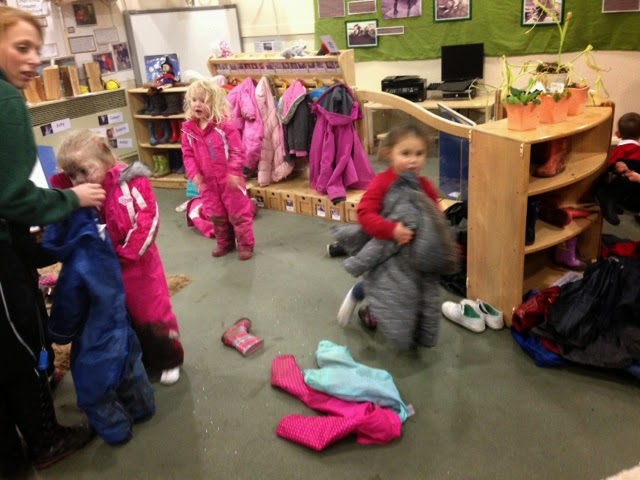


Hot chocolate and bottles of milk are available through the play time and children are free to get these themselves. At one point all the children are gathered around the fire for songs and a snack. Play then resumes until lunch time. All children come indoors and some are collected while others are given a hot lunch, as some stay all day. The water proofs, jackets and wellies are all taken off and shoes put on and the children again play with materials in their family groups until they are gathered for a group reflection, casual conversation or story as parents arrive to take the morning children home. The staff then manage a quick break before the afternoon children arrive and the routine begins again. 


DOCUMENTATION with Alison
As educators in early childhood this statement from Alison may resonate. "Documentation is something we are always grappling with. Although we've been working on it for years, we've never fully cracked it. There is so much we value, so many wonderful interactions, it's always hard to decide what will be documented and how." Sound familiar? 

Alison went on to share her expertise with me, and I must thank her here for her time and willingness to do so in her busy day. They work here from 8:30 to 4:30, but often stay much later and they only get a short break at lunch. 
So these are the things Alison shared with me. She began by pointing out:
*We need to consider the what, where and how, and this is dependent on the audience 
*We try to have a logic to how we go about it

I've noted here the various types of documentation that are developed and used at Boldon

Wall displays 

May be for parents, visiting professionals or the children
Based on big projects that have interested a lot of children
Involve children with a common interest or focus


Floor books 

Written with the children and document learning while it happens
Developed when children express an interest. 
Children and educators capture ideas through writing, drawing , mark making
Photos are taken and given to children to cut out and place on, usually by the next day and educators scribe the children's thinking
Possible Lines Of Direction (PLODS) are considered and developed by staff 
The projects go where the children lead
   Eg: an interest in sticks >> children attempting to join sticks >> introduce tools for joining wood >> a building project commences


Weekly journal

Each week a display is put up for parents in the form of a notice board with photos, quotes, items of interest or happenings during the week. The display includes a large book where a page is developed each week to inform parents of the children's learning, interests, focuses. 


Continuous provision

Provisions that occur on a daily basis are documented in a book available to parents and regulators. The environment is considered a third educator
Include the following titles: 
*learning opportunities, 
*role of the adult
*possibilities documented for each play area
These are the framework to the various provisions. Within this framework educators still consider:
*How it might be enhanced over time
*Plan for opportunities and possibilities. 
*How each learning area has the potential to hit all of the curriculum


Individual journals

Each child is provided with a learning journal. They include the following:
*Records of what happens for the whole centre
*About me page where parents contribute
*Key person profile that tells a little about the educator who is responsible for the child
*First days are documented
*Specific learning activities that the child has done and documented as annotated photographs
*Art work and educator reflection, often a photo
*Individual learning stories (parent and child friendly)
These are narratives written in first person 
*What I notice 
*Learning
*Possible next steps
Focus children. Each child gets a turn at being the focus child for the week and this involves parent input which is documented in the journal
*Send something home for parents
*Anything special, interests
*Notes from parent meeting and future directions for the child
*Key person comments and builds future directions for the child in response to the parent meeting. 


Assessment

Each educator needs to complete formal assessments on each child in their group, 26 per educator. These are required by Osted (our equivalent to ACECQA) and are based on their curriculum (similar to our EYLF)
Only one educator here is a teacher and there are 46 children attending daily. The legal ratio is 1:13 but Sue employs extra people to bring this down to about 1:8. The staff have varying levels of qualification that seem to be equivalent to our cert 111 and associate diploma
All educators have equal loads and responsibility in terms of documentation despite their level of qualification. 

Other forms of documentation   

The staff also document some of the key learning that they see taking place, using a journal, reflection style. Children may contribute also, but it's mostly the educators' ideas or thoughts. These are considered living, breathing documents that develop over time
For example
*A counting/numeracy book 
*Allotment book, what children are experiencing and learning from growing vegetables and keeping chickens
*Another example might be literacy and how children are responding to various forms

But wait, there's more

A parent book documents the learning and engagement of parents. 
A visitors book documents the responses, letters, thank you's from visitors

I asked Alison about the professional learning that was provided to support them in documentation. They have Professional Learning days, three a year, and all of the staff attended training for a day at Mindstretchers, with Kate and Claire Warden. This involved theory and presentations but also lots of practical hands on examples of how to use floor books, mind maps and journals. This helped them to come up with ways forward and they've been tweaking it ever since. 


All I can say is WOW! The work that is done is comprehensive, authentic and contextual to each child. I could see children's development throughout.

So that's basically what I wanted to share from my last few days at Boldon. I'll be in Denmark for the rest of the week so it'll be very interesting to see the differences and similarities. 

Wednesday, 2 April 2014

Day two at Wingate

I came to the nursery early today as I was invited to join in on the group time that children experience on arrival. Each child is part of a small group of eight children that meets with a key educator throughout the day. The children arrive and are able to play with activities as they wait for everyone to arrive and for the group time to begin. 

Mandy, the key educator for this small group begins by collecting the various items children brought to talk about and these are put on the table each child tells his or her peers about it. Mandy asks open questions, such as "what can you tell us about this." and the child responds with descriptions and ideas. Other children are free to comment and respond, always with the expectation that they listen to the person that is speaking and not interrupt others. The conversation flows easily, children are respectful of each other and the educator facilitates without taking over. It reminds me a bit of meal times around the family table. There are no hands up, no stilted silences while children attempt to answer meaningless questions. 

Mandy has a note pad and a pen and reminds the children of what they had started thinking about from yesterday's meetings.  One of the children is going to celebrate a birthday in a month at the beginning of May so an advent calendar had been started with ruled lines and approximations of numbers. The children are then asked their ideas about how to finish this project. Options for holding chocolates are suggested and agreed upon. When it came to play time the children were expected to commit to something that the group has been working on at least for some of the time and are supported in this. A busy hub of activity is the result, with children collaborating in small groups to get the agreed tasks completed, sometimes with the help of educators but also independently. There is an air of constructive purpose as children go about these tasks. Some were designing a park for chickens, some were decorating a cake, others were building a home for dragons and others went onto the workroom to work on designs. A small group were outside to make a picnic for the chickens. There were numerous projects going on at the same time, all child led and child driven. 

I joined the group of children outside in the mist and the rain with their key educator Glynis. They were collecting bugs and creepy crawlies to make a picnic for the two chickens. Oh boy, here we go again. Poor worms. I did advocate for the beautiful black beetle though and he got to go in a little cage with bark and soil to keep him comfortable until it's time to release him. 

With Glynis's support the children shared the food they had prepared, including cheese, pasta, and mini beasts. It had to be fair and mathematical knowledge was promoted with the use of words like half, some more, a bit less. They divided and shared the picnic, decided on how many worms to sacrifice and how many to set free and what to do about the slugs. Seven slugs were put back under a log, three more were found to have escaped and were still on the table top. How many altogether?


So you get the idea don't you? The scope for authentic and contextual learning was provided, facilitated, deepened. The children were highly involved, engaged and were given opportunities for leadership. 

When we came back in the children again gathered in small groups with their educators. I sat with the group that had been preparing the chickens' picnic.  The discussion centered on what the children knew, what they had discovered and what they were thinking about. Glynis took notes and assured the children that this would help her to remember what they had learnt and what she needed to bring to tomorrow's learning. 

During these 'family group times' the discussions are free flowing, give every child a voice and encouraged the children to share their ideas and knowledge. At one point the little beetle was found within its protective compost and taken out for a closer look. A child enthusiastically asked to hold it and in a blink it had disappeared. There was then a frantic search while all needed to keep still so as not to crush it. We decided it had gone, was lost, probably in the dark space under the cupboard. 

The discussion resumed until a little girl, eyes popping and body squirming announced that the beetle was in her jumper. A bit of a search revealed nothing. She sat back down, seeming only partly assured. In minutes she was up again, giggling and squirming and the beetle popped out of the neck of her top. She jumped with the tickling and then disaster! The beetle ended up on the lap of the one child who had been saying constantly "I don't like beetles". Well Glynis kept her calm but that beetle was fast and jumpy. It was eventually recovered amongst much squealing and laughter and the child who didn't like them was very still while the beetle was snaffled and put safely back in its container. Crisis averted! We all congratulated that little girl in being so calm when she really hated having the little bug on her. I was impressed with her resilience. 

Documentation is something I looked at in close detail today. They do a great deal of high quality documentation all based on the children's interests and activities. I like that there is a variety of methods used, from learning stories to snippets of learning to ideas on possible lines of development, noted conversations transcribed and plenty of photographs as well as children's artwork. Parent input is invited through various means and some of the children's learning journals contain notes and stories from home as well as lots of home literacies such as tickets, maps and programs gleaned from outings on weekends. The educators keep their own journal where they document their family group times. Also, the walls tell the stories of significant things that children are learning about. 

The children's journals are so comprehensive and give such a clear picture of each child's passions, learning and development that they could stand alone as the documented program, although here they are also expected to keep comprehensive developmental records as well as develop child profiles in addition to the portfolios.  The journals, however, show a cycle and progression of development and learning and focus deeply on projects that the child has been engaged in. They are a record of the educators curriculum, true and authentic. They connect to the children's worlds. The staff are given great autonomy in developing these and none of the educators on the floor are fully qualified early childhood teachers. They all have EC qualifications of varying levels and their knowledge and passion for how young children learn and their part in the journey shines through. They are in a supportive learning environment that has high expectations of everyone, and the staff here live up to these expectations. 

So here I sit on my bed in my hotel sipping a delicious red wine and thinking I should be out, but I'm so tired. My brain hurts, it is so full of all the wonderful things I've been shown today. Wingate have developed a number of training resources and I've purchased a few to work through with my teams back in Australia. 

I would like to mention before I close for the evening, that Lyn, the lady who cooks the meals for the day care children, kindly made my lunch today. I was invited to share in the children's curry and Lyn made a vegetarian version just for me. It was truly delicious and made all the more so by her kind hospitality and by the wonderful company of Paddy and Beccy. 

Thank you also to Glen for our afternoon chat, and to all of the staff and children for welcoming me so whole heartedly. 

Bye for now. Talk tomorrow.